
About WINNERS
The plant behind the specification
HUZHOU WINNERS ARMOUR CO., LTD. was founded in December 2022 with registered capital of RMB 2.8 million. We make unidirectional and woven ballistic fabric at Room 102, Building 2, No. 118 Hongqiao Road, Qianyuan Town, Deqing County, Huzhou, Zhejiang, China.
Equipment and process
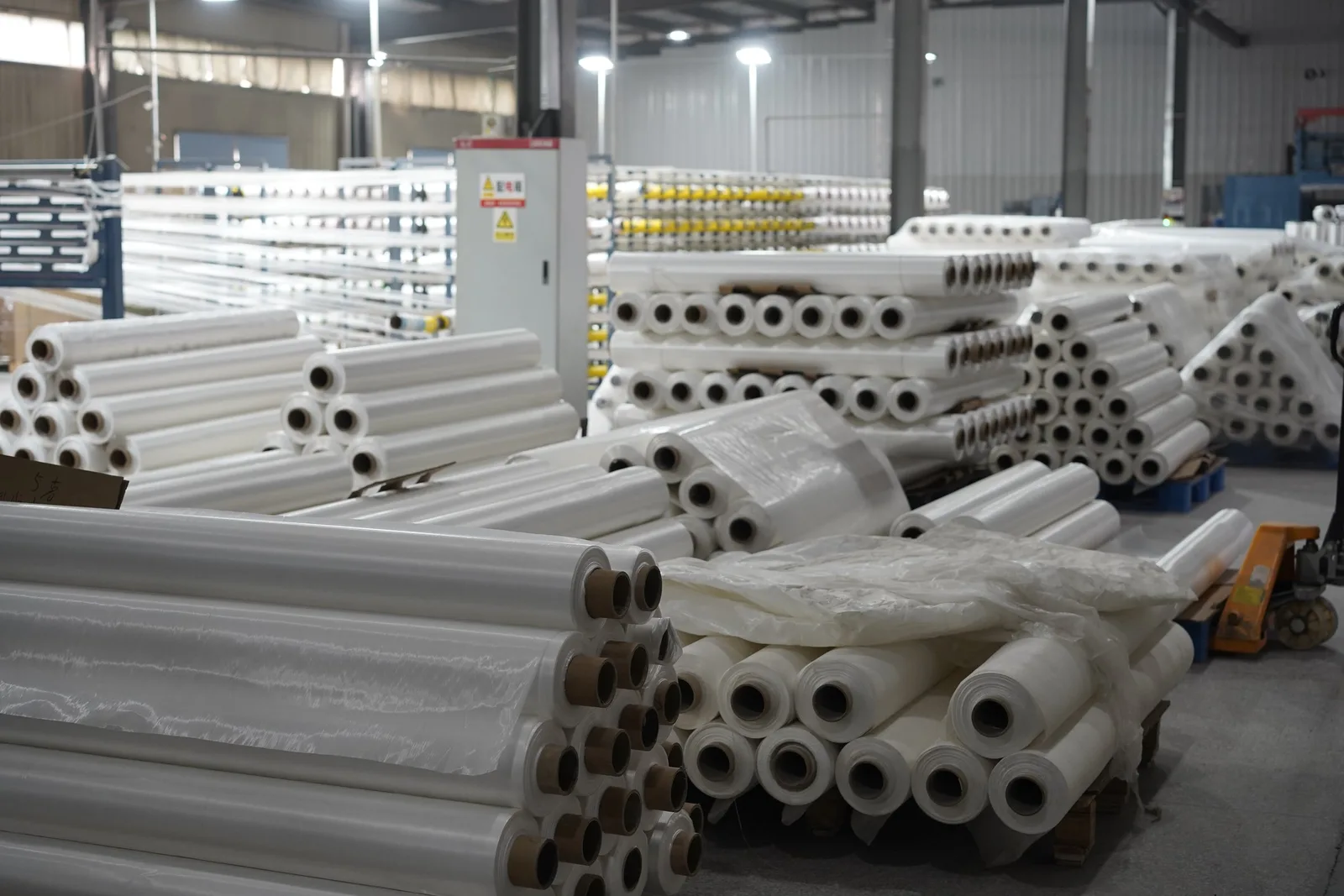
The plant runs over 60 sets of large-scale production equipment and moulds. UD and woven lines sit under one roof, so a customer changing from woven cloth to UD fabric stays with the same supplier.
Management systems
Company
Location and logistics
Deqing County, one hour from two ports of exit
Short inland haulage keeps roll damage and freight cost down, and it makes a plant visit easy to fit into a trip to either city.
Water
Road
Shanghai
Hangzhou
Certificates and approvals
The documents, as scans
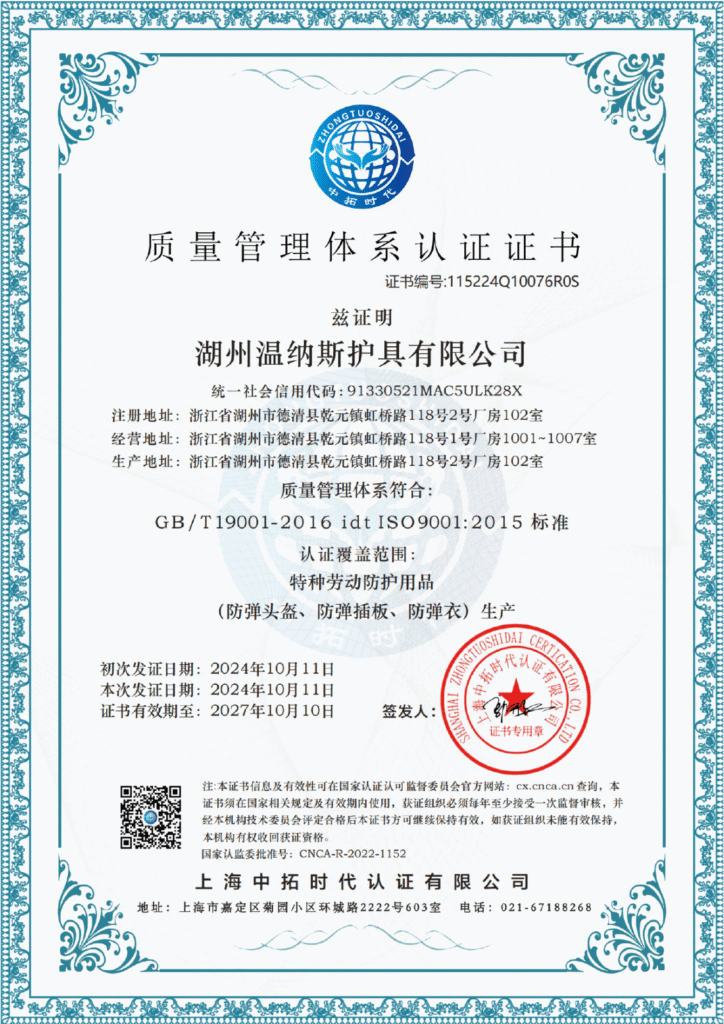
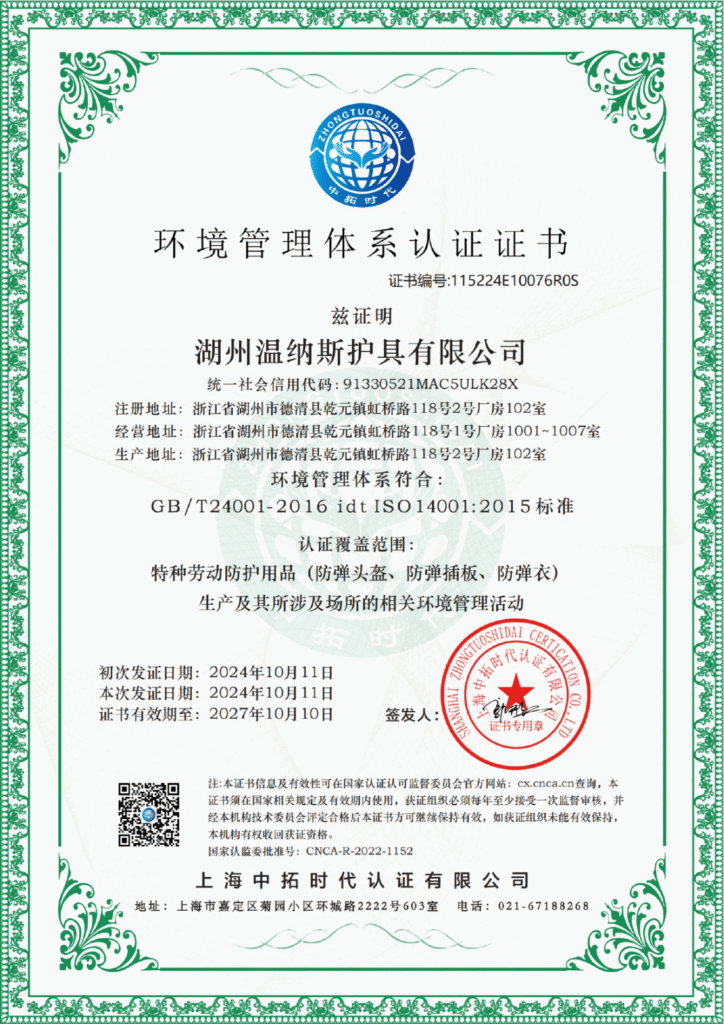
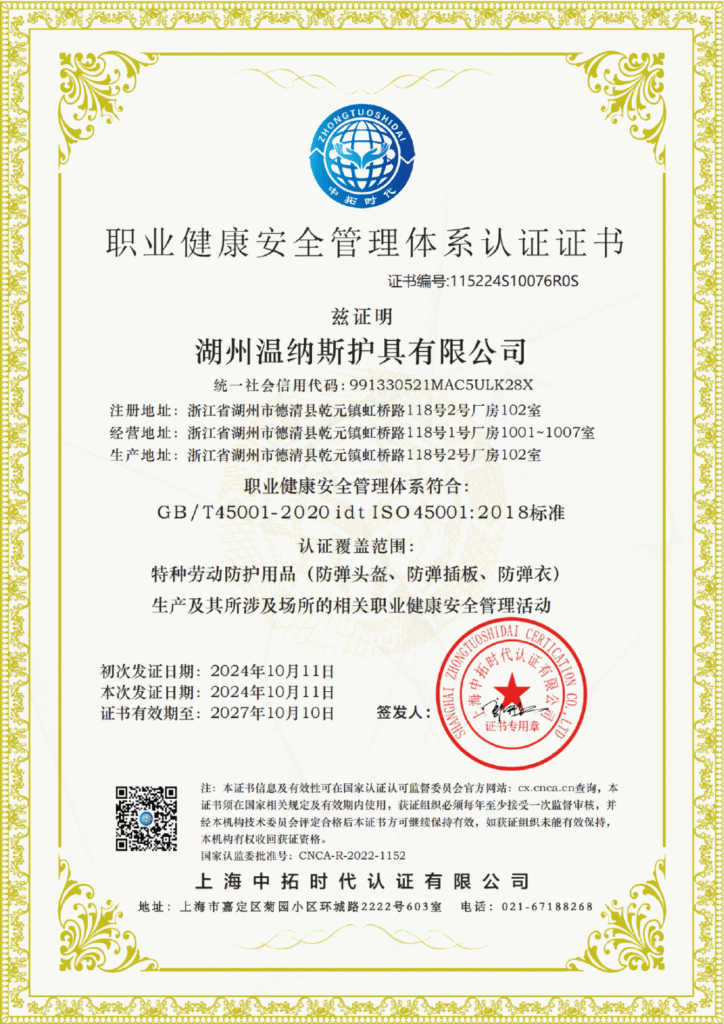
Open any thumbnail to read the full page. The three ISO certificates are issued to HUZHOU WINNERS ARMOUR CO., LTD. and cover production of ballistic helmets, plates and vests at the Hongqiao Road plant.
Test reports available
Two sample reports, twelve in the file
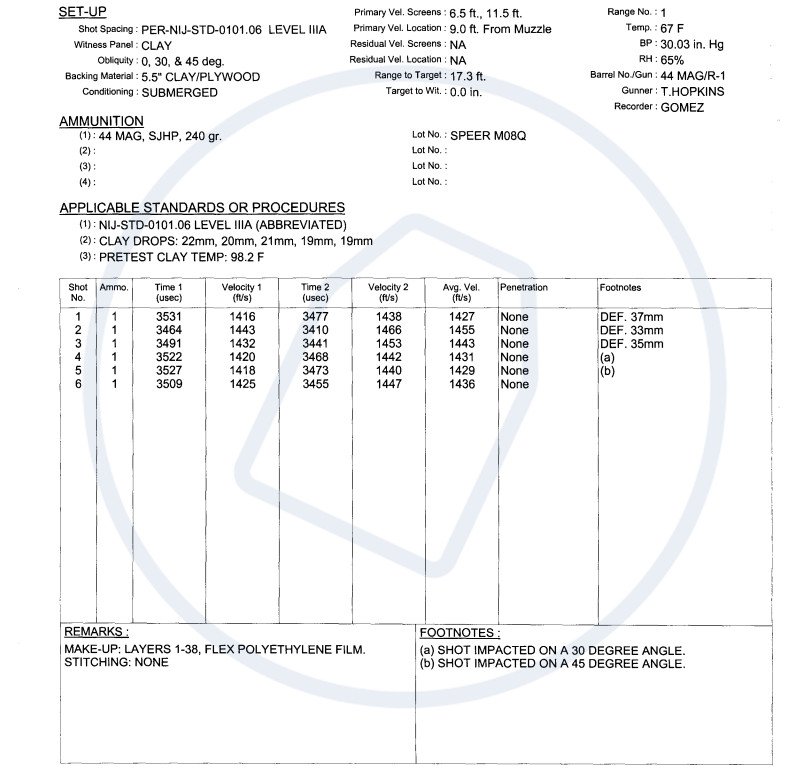
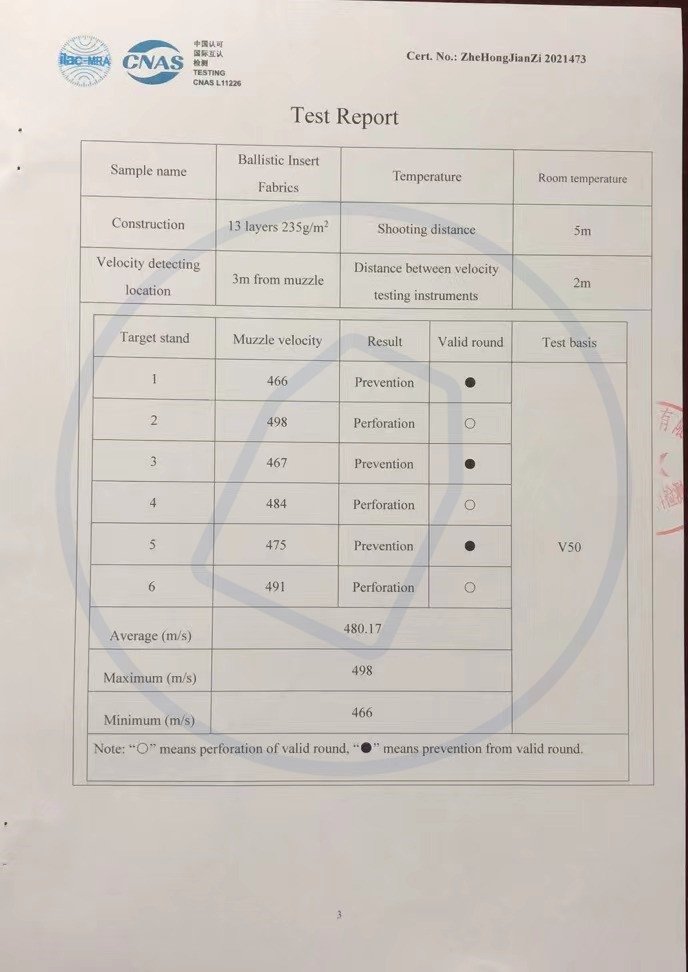
We hold 12 ballistic test reports on our fabric. The two below are published as samples so you can see the format and the level of detail. Ask Ida for the report that matches your own lay-up and we will tell you what we can send.
Standards library
The standards our fabric is tested against
Plain descriptions of what each standard is and what it measures, for anyone who has to read a report without living inside these documents every day.
The United States National Institute of Justice standard for the ballistic resistance of body armor. It sets the test rounds and velocities for each level, and limits how far the armor may deform into a clay backing behind the shot. Level IIIA is the soft armor level, tested with .44 Magnum SJHP and 9mm. NIJ certifies finished torso-worn armor, not fabric, so we describe our fabric as tested to NIJ 0101.06 and never as NIJ certified.
The 2000 revision of the same body armor standard. It uses lower test velocities than 0101.06 for the same level names, so a panel that meets Level IIIA under 0101.04 needs fewer layers than one meeting Level IIIA under 0101.06. Where our tables quote 0101.04 we say so, because the two are not interchangeable.
The Chinese national military standard covering requirements and test methods for military body armor, including fragment protection. Our V50 figures against a 17-grain fragment simulating projectile are measured to this standard or to STANAG 2920.
A NATO test method for measuring the ballistic protection of materials against fragments. It defines how V50 is obtained: the velocity at which half the shots pass through the sample and half are stopped. V50 compares materials at equal areal density. It is not a protection level and it is not a pass or fail result.
The Chinese public security industry standard for police ballistic vests. It sets protection levels against the rounds Chinese police issue, including 7.62x25mm, and limits back face signature. Our SB160 report from November 2022 was tested to level 2 of this standard, at room temperature and at 60 degrees C.
Testing partners
Where our fabric is shot
We do not self-certify ballistic performance. Fabric goes to independent test centers, and the reports below are available on request.
Scroll the table sideways to see all columns.
- • Test results describe the configuration that was shot. A change in layer count, resin, panel size or temperature changes the result, so ask us for the report that matches your own lay-up.
Next step
Ask for the report that matches your lay-up
A test result describes the configuration that was shot. Send us your layer count, panel size and the temperature condition in your specification, and we will tell you which of the twelve reports fits.